

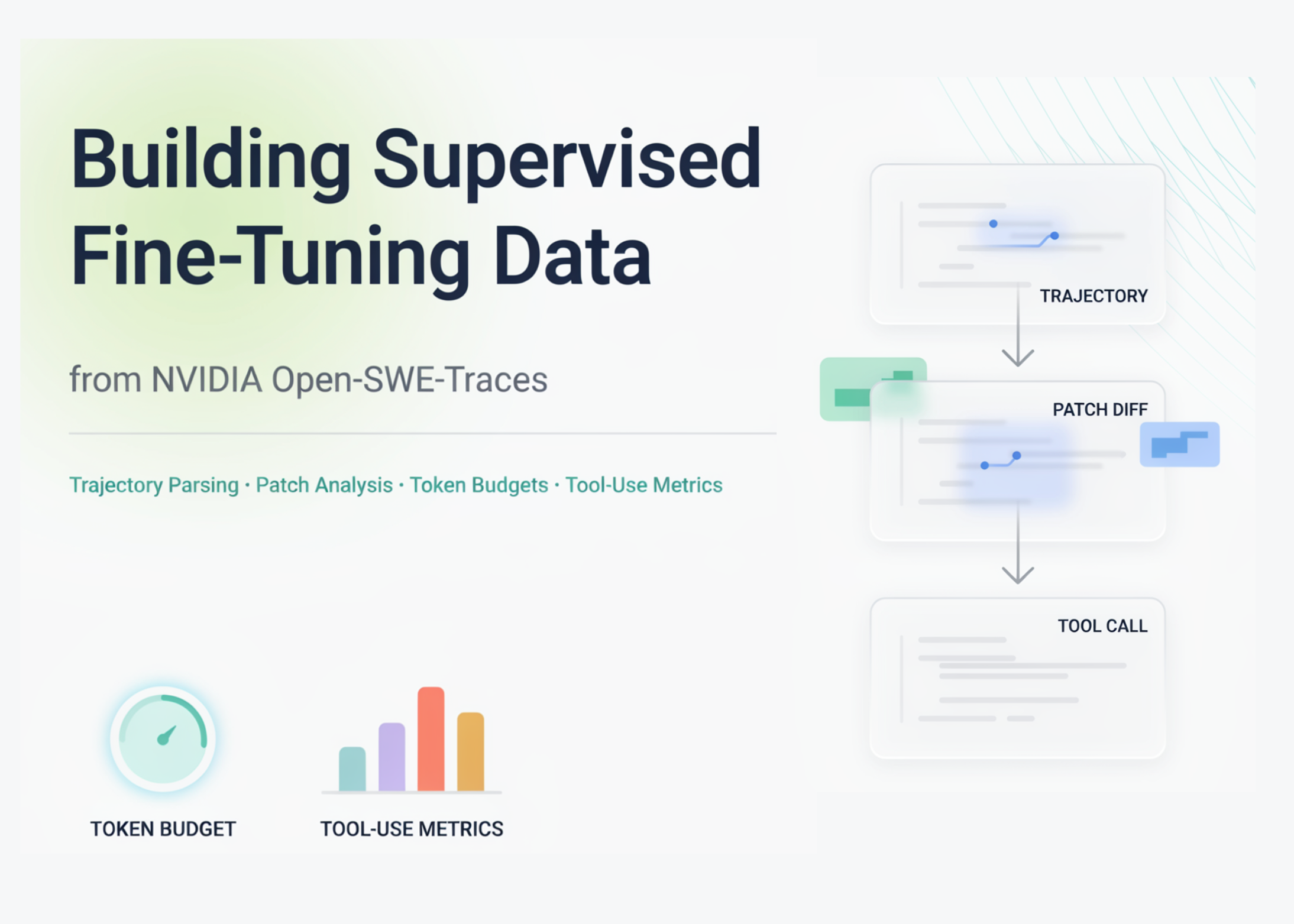
When NVIDIA drops a massive, open‑source dataset of real‑world software‑engineering interactions, the AI community takes notice. The Open‑SWE‑Traces archive offers a goldmine of multi‑turn agent conversations, code patches, and tool‑usage logs—everything a fine‑tuned large language model (LLM) needs to learn how to write, debug, and refactor code like a seasoned developer.
Why Open‑SWE‑Traces Matters for Fine‑Tuning
Traditional supervised fine‑tuning relies on static, hand‑crafted pairs of prompts and ideal completions. Open‑SWE‑Traces flips the script by providing live, agentic dialogues that mirror real‑world programming workflows. By training on these trajectories, models can capture the nuances of tool invocation, error handling, and iterative patching—skills that static datasets miss.
Streamlined Data Access: Hugging Face + Colab
The tutorial shows how to pull the data directly from Hugging Face’s hub, sidestepping bulky downloads. A single Python snippet streams the entire archive into a Google Colab notebook, allowing developers to:
- Filter by language (Python, JavaScript, etc.)
- Segment by project size or domain
- Instantly generate training shards without local storage constraints
Key Processing Steps Explained
1. Trajectory Normalization: Convert irregular, multi‑turn dialogs into consistent, turn‑by‑turn interactions. 2. Patch Extraction: Isolate the final code changes from each conversation, turning them into high‑quality training examples. 3. Metric Compilation: Build a DataFrame that tracks trajectory length, token budgets, tool‑use counts, and resolution success rates.
What the Metrics Reveal
Analyzing the dataset opens a window into how agents actually work:
- Average trajectory length: 12 turns, indicating deep iterative debugging cycles.
- Tool usage spike: 45% of turns involve calling external APIs like GitHub Copilot or static analyzers.
- Patch size: Median lines added or removed per commit hover around 6, matching typical GitHub pull requests.
- Resolution rate: 78% of conversations finish with a working code patch, a promising baseline for training goals.
Building a Supervised Dataset from Scratch
The tutorial walks readers through curating a clean, balanced training set:
- Drop low‑confidence or incomplete trajectories.
- Balance language distribution to avoid bias toward any single stack.
- Tag each example with tool‑use metadata, enabling future “tool‑aware” fine‑tuning.
Real‑World Impact: From Research to Product
Companies like Microsoft and GitHub already leverage similar patterns to enhance Copilot. By incorporating Open‑SWE‑Traces, startups can rapidly prototype LLMs that:
- Understand context across multiple turns.
- Invoke relevant tools automatically.
- Deliver concise, bug‑free patches.
Next Steps for Developers
Ready to dive in? Follow the tutorial, tweak the preprocessing pipeline, and watch a fine‑tuned model outperform its baseline on a suite of coding benchmarks. The future of AI‑assisted programming isn’t just about generating code—it’s about mastering the entire development lifecycle.
Join the conversation: share your fine‑tuning experiments, ask questions, and help shape the next wave of intelligent code assistants. Happy coding!


💬 Comments
Comments
Post a Comment