

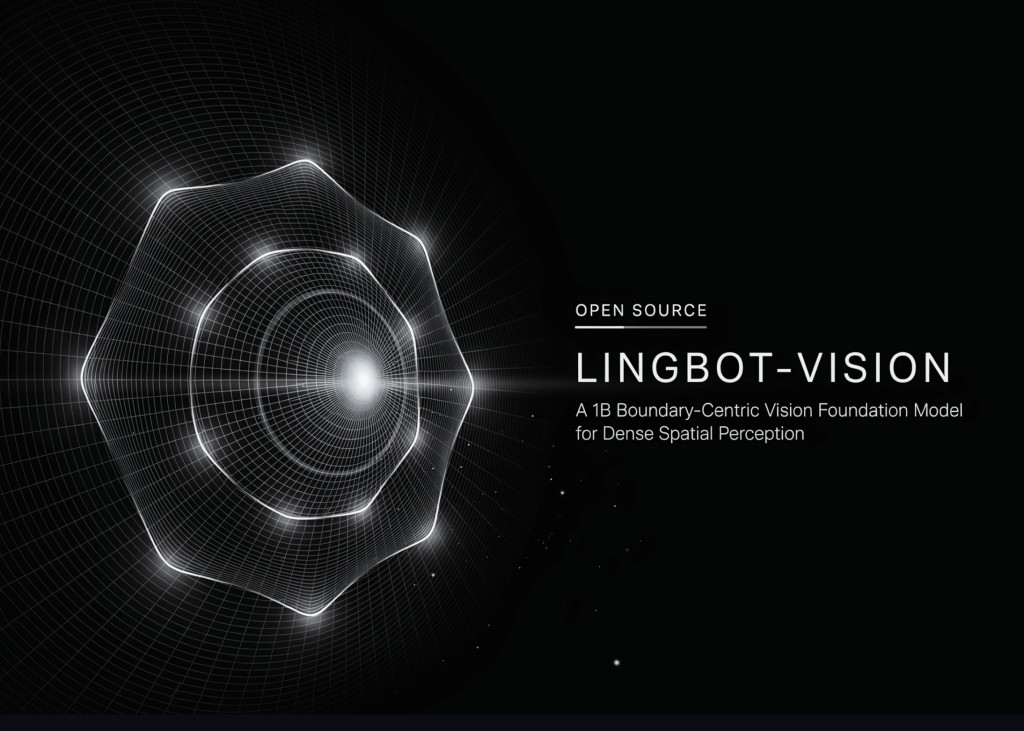
When Ant Group announced the release of Robbyant’s LingBot‑Vision last week, the AI community was quick to notice. The open‑source model, boasting a 1‑billion‑parameter backbone, challenges the notion that bigger is always better.
What Makes LingBot‑Vision Stand Out?
Unlike traditional vision transformers (ViTs), LingBot‑Vision treats image borders as a primary learning signal. By masking and predicting boundaries, the model learns fine‑grained spatial relationships that are critical for tasks like segmentation and depth estimation.
Key Features & Technical Highlights
- Boundary‑Centric Training – Uses masked boundary modeling to create a native training signal, improving edge detection.
- 1B Backbone – A surprisingly compact architecture that matches or exceeds the performance of much larger ViT models.
- Self‑Supervised Learning – Trains on unlabeled data, reducing the need for costly annotation pipelines.
- Dense Spatial Perception – Excels in pixel‑level tasks such as semantic segmentation and instance segmentation.
- Buen Initializer for LingBot‑Depth 2.0 – The new depth model inherits learned features, cutting training time by half.
Practical Implications for Developers
Because the model is open‑source, teams across the US, UK, and Canada can integrate LingBot‑Vision into their pipelines without licensing fees. The boundary‑centric approach also means fewer training images are required, saving storage and compute costs.
Industry Reactions
Tech leaders are already seeing the potential. A senior engineer at a leading automotive startup noted that dense spatial perception is “the missing link” for autonomous navigation. Meanwhile, a researcher at a UK university highlighted the model’s ability to generalize across diverse datasets.
Getting Started
The repository on GitHub includes pretrained weights, a step‑by‑step fine‑tuning guide, and sample code for common vision tasks. Developers can fork the project, experiment with boundary masking thresholds, or contribute improvements back to the community.
Future Directions
Ant Group plans to release LingBot‑Vision variants tailored for mobile and edge devices, aiming to bring high‑quality vision to low‑power hardware. They also intend to expand the model’s multilingual capabilities, aligning with global AI standards.
Ready to push the boundaries of computer vision? Dive into LingBot‑Vision today, and help shape the next wave of AI innovation.


💬 Comments
Comments
Post a Comment